Overview
Manufacturing organisations are under pressure to modernise operations, improve resilience, control costs, and deliver transformation without disrupting production. Strategic initiatives often span plant operations, engineering, supply chain, quality, IT, procurement, finance, compliance, and leadership teams. Whether the focus is digital transformation, factory improvement, automation, systems migration, product introduction, site expansion, quality improvement, or operational efficiency, the same challenge appears repeatedly: delivery activity is happening, but strategic oversight is often fragmented.
P3MO addresses that challenge by providing a structured platform that connects strategic priorities, delivery programmes, governance, evidence, and reporting in one environment. Instead of relying on disconnected spreadsheets, slide decks, local trackers, and informal updates, manufacturing leaders gain a clearer line of sight between board-level objectives and day-to-day execution.
For manufacturers, this means P3MO can be used to strengthen project delivery and improve strategic oversight at the same time. It supports clearer governance, stronger collaboration, better decision-making, and more confidence in the data used by senior leadership teams.
Why manufacturing delivery is complex
Manufacturing change is rarely confined to a single function. A new plant initiative or transformation programme may affect operations, production planning, maintenance, quality management, engineering, warehousing, supplier coordination, data systems, customer commitments, and workforce capability all at once. That makes delivery inherently cross-functional, and cross-functional work is where visibility often starts to break down.
Many organisations already have capable project teams, but they still struggle to create one trusted view of progress, dependencies, decisions, and risk. Status can sit in different tools, local priorities may override portfolio priorities, and leadership updates can become disconnected from the operational realities on the ground. The consequence is familiar: decisions are delayed, issues surface too late, and executive teams spend more time validating the numbers than acting on them.
In sectors where throughput, quality, safety, and customer delivery all matter, this lack of strategic visibility can quickly become expensive. The problem is not always the quality of individual projects; it is often the absence of a consistent governance layer that links them back to strategic outcomes.
Where P3MO fits in manufacturing
P3MO is designed to sit between strategy and execution. It gives leaders a structured way to connect portfolios, programmes, projects, milestones, risks, decisions, owners, and outcomes so delivery can be understood as part of a wider business system rather than as isolated project activity.
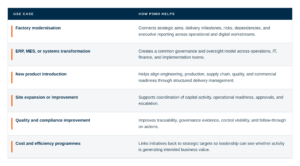
In the manufacturing sector, that makes the platform relevant to programmes such as:
- Factory modernisation and smart manufacturing initiatives.
- ERP, MES, and operational systems change.
- Capacity expansion and site improvement programmes.
- New product introduction and industrialisation activity.
- Quality, compliance, and audit improvement initiatives.
- Supply chain transformation and resilience programmes.
- Cross-functional efficiency and cost-reduction programmes.
Rather than forcing each team to report differently, P3MO creates a common management structure for oversight. That helps senior teams understand not only what is being delivered, but how delivery supports strategic objectives, where risks are accumulating, and which interventions will make the most difference.
Supporting stronger project delivery
Project delivery in manufacturing depends on timing, coordination, and control. A delay in one workstream can create knock-on effects across operations, procurement, commissioning, quality, staffing, and customer delivery. That means isolated project reporting is not enough.
P3MO supports stronger delivery by making interdependencies more visible and by providing a shared structure for action tracking, escalation, milestone management, and governance review. Teams can work within a more consistent delivery model, while leadership gains a clearer view of which projects are moving, which are blocked, and where intervention is needed.
This is particularly valuable in programmes that combine physical, operational, and digital change. When factories are introducing new technologies, equipment, workflows, or controls, success depends on multiple teams staying aligned around a common delivery picture rather than each function optimising in isolation.
Improving strategic oversight
Strategic oversight is more than receiving a monthly status report. In manufacturing, leaders need to understand whether major initiatives are aligned to business priorities, whether resources are being applied effectively, whether risks are emerging in time to act, and whether expected benefits are actually materialising.
P3MO improves strategic oversight by linking executive objectives to the delivery structures beneath them. This allows leadership teams to see how initiatives connect to wider themes such as operational efficiency, digitisation, resilience, quality performance, customer service, and margin improvement. It also helps separate activity from impact: an initiative may appear busy, but that does not necessarily mean it is advancing the strategy.
A more structured oversight model makes it easier for leadership teams to ask better questions:
- Which programmes are most important to strategic outcomes?
- Where are dependencies creating delivery risk?
- Which issues need executive intervention now?
- Are resources spread too thinly across competing priorities?
- Can the business evidence progress against intended outcomes?
That shift from fragmented reporting to structured oversight is where P3MO becomes strategically valuable.
Driving collaboration across functions
Manufacturing transformations frequently fail at the seams between teams rather than within the teams themselves. Operations may be ready but systems are not. Procurement may have delivered equipment, but training is incomplete. Engineering may complete technical work while quality or compliance sign-off lags behind. Each team may be performing well individually while the programme as a whole drifts.
P3MO helps reduce that risk by giving functions a shared environment in which ownership, dependencies, progress, issues, and approvals can be seen more clearly. This makes collaboration more practical and less dependent on manual coordination.
The benefit is not just better communication. It is better alignment. When operational teams, engineering, IT, finance, and leadership are working from the same delivery structure, meetings become more focused, handoffs improve, and accountability becomes clearer.
Strengthening auditability and control
Many manufacturing environments also carry high expectations around traceability, quality control, compliance, and change discipline. Even where the organisation is not operating in a heavily regulated niche, leaders still need clear evidence of what was agreed, what changed, who approved it, and what outcomes followed.
P3MO strengthens that control environment by supporting structured governance, clearer records of decisions and actions, and better visibility of progress and escalation. That is valuable for internal assurance, external review, audit preparation, and executive confidence.
In manufacturing settings, this can support:
- Better control of project changes and approvals.
- Clearer evidence of delivery decisions and governance activity.
- More reliable handover from project work into operational ownership.
- Stronger visibility of risks, exceptions, and unresolved actions.
- Improved readiness for quality, customer, or internal audit review.
The aim is not to add bureaucracy. It is to create enough structure that important delivery activity can be trusted, reviewed, and improved.
Building belief in data
One of the biggest leadership challenges in manufacturing transformation is trust in data. Senior teams often receive multiple reports from different functions, each with different assumptions, timelines, and priorities. By the time information has been consolidated into a board pack or steering paper, confidence in its accuracy may already be low.
P3MO helps improve belief in data by making information more structured, connected, and contextual. A delivery status becomes more meaningful when it sits alongside milestones, risks, decisions, commentary, ownership, and evidence in one place. A reported benefit becomes more believable when it can be traced back to agreed objectives and programme activity.
For manufacturing leaders, that means more confidence in decisions about priority, investment, intervention, and sequencing. It becomes easier to distinguish between apparent progress and real progress, and easier to act before issues become operational problems.
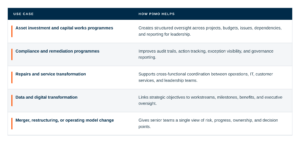
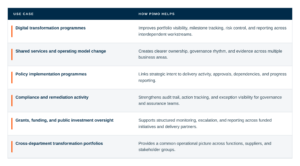
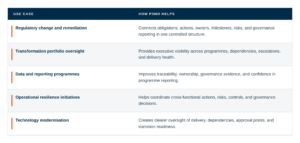
Manufacturing use cases
The platform can support a broad range of manufacturing scenarios.
Value for leadership teams
For manufacturing leadership teams, the real value of P3MO is that it provides a trusted operating layer for change. Instead of viewing strategic programmes through fragmented reports and disconnected conversations, leaders can govern delivery through one clearer structure.
That can help leadership teams:
- Improve confidence in delivery reporting.
- Prioritise interventions more effectively.
- Strengthen cross-functional accountability.
- Reduce time spent reconciling conflicting updates.
- Create better visibility from strategy through to execution.
- Support more consistent follow-through on decisions and actions.
In manufacturing, where disruption is costly and execution risk can affect customers, margins, and operational performance, that kind of oversight is not a nice-to-have. It is a practical leadership advantage.
Implementation approach
P3MO is most effective when introduced as part of a defined operating model for governance and delivery rather than as a standalone reporting tool. In manufacturing, that often means starting with a key strategic area such as digital transformation, plant improvement, systems change, or an executive portfolio of high-priority initiatives.
From there, the organisation can agree a common structure for risks, actions, milestones, reporting, decisions, approvals, and outcome tracking, then use the platform to make that structure visible and usable across teams. Once the benefits of a shared model are established, the approach can expand across broader programmes and sites.
Closing perspective
Manufacturing organisations do not usually struggle because they lack ambition or activity. They struggle because strategic initiatives are often governed through fragmented tools, inconsistent reporting, and delivery models that make oversight harder than it should be.
P3MO helps close that gap. By connecting strategy, delivery, governance, and evidence in one platform, it supports stronger project delivery and better strategic oversight across the manufacturing sector. The result is clearer control, improved collaboration, stronger confidence in data, and a more reliable link between transformation effort and business outcomes.
If you would like to discuss how P3MO can support your programmes please reach out to the team at P3MO [email protected] or feel free to contact me directly [email protected]